

Viktor Schauberger was born the 30th of June 1885, he later died the 25th of September 1958. Viktor was a successful inventor and invented several inventions that used vortex like patterns that copied nature.
Viktor Schauberger was an Austrian forester who was active during the first half of the 19:th century. He had a huge beard and a friendly laughter, this he combined with an uncompromising belief in himself and his ideas. He was obstinate in combination with a choleric temper. He was a good drawer and probably a skilled craftsman. Even if Viktor was not schooled the academic way he had a deep knowledge in biology, physics and chemistry. His sense and understanding on how water flows in the nature was exceptional. From his observations he formulated his new hydrodynamic basic theory. His friends and opponents described him as highly intelligent and with this intellectual sharpness he made a deep cut in his (and ours) physical paradigm.
During World War Two, Victor Schauberger was interned in a Nazi concentration camp and was forced to work on a flying disk project using his ideas. It is not known if the project was completed, or, if the saucers actually flew in Germany. Reports vary, and no confirmed documentation remains. It is rather convincingly coincidental, however, that our own (US) pilots reported "strange flying disks" over Germany just prior to the War's end. After World War II, Viktor migrated to the United States on promises by various agencies (CIA) to help him develop and test his ideas. Those promises later proved to be hollow. He went to a facility in Dallas Texas, and under uncertain direction, signed over all of the rights to his inventions and patents, to, none other than the US government (Army, Navy...who knows?!). He was sent back to his home-land of Austria, only to die, broken and disillusioned five days later. It would make a great headline for the 'National Enquirer'...and unfortunately...it's TRUE!
His Inventions: The Repulsin:
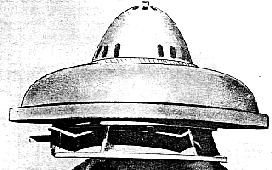
An original picture-sketch of the Repulsine above : A flying model of a Schauberger Repulsine, Type A, tested in January 1940. This device has been built with copper and uses a very high speed motor for the main vortex turbine. The Repulsine Type "A" device is an Electro-Aero-Dynamic device (E.A.D.) and uses two effects :
1.) The Coanda Effect: a pure Aerodynamic effect based on the Bernoulli's principle.
2.) The Electro-Dynamic effect : The high speed vortex in the "vortex chamber" produces an electric, charged separation effect, called "the diamagnetic effect " by Schauberger. These two effects, combined, create the so-called "implosion effect".
When the main electric engine is started, the Coanda effect begins to create a differential aerodynamic pressure between the outer and the inner surface of the primary hull. At a higher speed, the vortex chamber becomes a kind of high electrostatic generator due to the air particles, in high speed motion, acting as an electrical charge transporter. The Repulsine will begin to glow due to the strong ionization effect of the air. Now, we have all the ingredients for a continuous and strong Aether Flow along the main axis from the top to the bottom of the craft...The radial air pressure required for lifting 1kg with the Coanda Effect is about 1,4 kg/cm2
Machines of Genius - The Repulsine, or "Flying Saucer" of Viktor Schauberger:
Viktor used implosion to run his devices, implosion created great power in his inventions. Also known as water-hammer or cavitation. Not very much is known about cavitation and how to apply it to inventions. Viktor however knew all too well how to use it in inventions.
When his repulsion would be in operation the turbine with the aid of implosion would create a propulsion effect which would levitate the craft into the air.
Most of the documentation you will find on Viktor Schauberger's work and inventions is almost always very technical. Experiments that you and I the struggling inventor can do to imitate his inventions are hard to come by. It would be nice if there would be some experiments we could try to see how his inventions actually work. I myself have searched through books written by him and on internet sites for actual experiments I could try to see how his inventions work. I have not found any. One of his books that does explain how he used water for anti gravity inventions is well explained for those who are not rocket scientists. It is a very good book. It explains how water really flows and how water is energized, it gives a lot of information on water flow and how he developed his anti gravity ideas from watching trout go upstream. He noticed that they jumped up over rocks and such when going upstream, he noticed a kind of anti gravity levitation when they jumped upstream. This allowed him to experiment and learn a lot about water flow. He also created several inventions for logging, his inventions for sending logs through water to designated areas were very successful. Viktor maintains that water should not flow in a straight line, water likes to flow in curves, like down a winding river, it energizes the water.
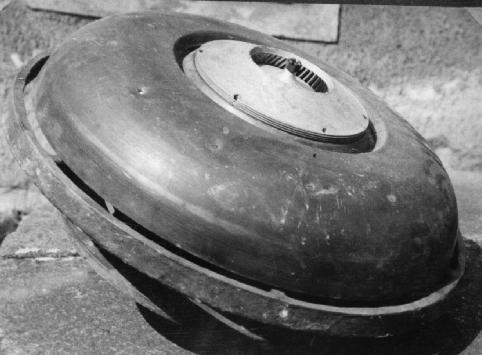
Repulsin B -To the Left is a picture of an original prototype showing the major components of the "Repulsine, type B" engine. The air, being drawn in from the top slits, is set into a spiral vortex movement. Schauberger had claimed that once the devise was set in motion, the primary motor could be switched off and the forces at work would power the generator, which was housed in a central location inside the craft.
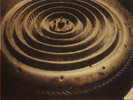
The implosion motor uses the suction forces of implosion; there is no heat barrier and no sound barrier, because with friction almost entirely lacking, no heat is generated. The air flows through the rotating air inlets, placed in the middle, and follows the gap between the double membranes (with the wave pattern). This creates a spiral contraction of the flowing medium and creates a vacuum which increases the "pull", via implosion. The enhanced vortex turbine uses two flat membranes with concentric "rills" on it. A wave pattern has been set on the upper and on the lower membrane. The upper wave is slightly out of phase with the lower wave. This is a direct application of the "Coanda" effect. The air flow passes through small cavities where the volume sometimes is larger, and sometimes smaller, due to the difference in phase relationship between the upper and the lower membrane. When the air passes different cavities it starts to pulsate. The pulsations are directly dependant on the angular speed of the discs. This "push-pull" action creates an harmonic pulsation of energy...
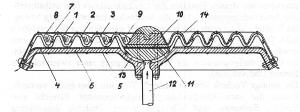
The Repulsine uses the same phenomena. Cold water, drawn through a base hole, is spun in between the two wavy impellers and cools the air inside the units’ shell. As this partial vacuum draws in the air, it is spun into a cyclone by intake fins. After the air is cooled and humidified, still spinning, it is then expelled from an upper turbine, which reacts with the exiting cyclone. This centrifugal air has so much angular momentum that it is able to leave the Repulsine, even against a strong internal vacuum. That is a direct analogy to the rocking tank implosion-based water pump, described above.
The hot, rising vapor, trapped in a snail-shaped chimney, is lighter then the surrounding dry air and adds to the suction on the Repulsine's top. The upper turbine, spun by the exiting cyclones' action, directly drives the internal wavy vaporizing discs, which atomize the cold intake water. The electric motor (used for starting purposes) only has one purpose, and that is to spin up the vaporizer so that it properly atomizes the cold water from the inlet hose. The power source is implosion of hot, dry, desert air.
Remember that the power source is the Thermal difference between cold ground water and hot, dry desert air, just as is done in the implosion tank-rocking water pump from Texas. There is no mystery here. This device does nothing but convert the energy present in the combination of cold ground water with hot dry atmosphere. That is how it actually works. In many ways, it is similar to Schauberger’s water turbine, which also uses a pulsed pressure reservoir. Keep in mind that without the cold-water input, the pulsating vacuum trapped inside the Repulsine soon diminishes and stops. There is a lot of mystery behind this device.
To quote on what Schauberger said:
“ I connected the implosion motor to an outdoor water tap and it began to spin and finally took off, powered off of nothing more then ordinary, cold, tap water.”
If you look at the Repulsine, you will find a water pipe beneath, sticking out to the side. Schauberger was a master of water implosion technology. It is possible to cool air by simply pulling on a piston, but you require work to do that. At the same time, if you compressed air in a piston, it will get hot. That requires force over a distance or mechanical work to accomplish. You see; there is no gain! Simply expanding a piston and contracting it (or a vortex) accomplishes little more then creating a spring. We all know springs eventually stop bouncing. Schauberger’s expanding and contracting tornado also eventually ceases without an energy source. Recall the Hilsch-Rankine tube or Maxwell’s demon. The tube generates spiral airflow and creates hot air in the large tube and cold air -140F in the small diameter tube. In order to accomplish this, compressed air in large volumes must be used for its ability to do work. No free ride there. It is possible to make a vertical tube howl like a banshee, but the second the flame is removed from the tubes’ inside wall - the resonance stops. Again, it requires a defined energy source. That is Viktor Schauberger’s secret.
Hopefully someone will soon come along who will explain it to us in plain English how his devices work, and show us a prototype of similar design to Viktor's. If we are to combat Climate Change and natural disasters technology using Viktor's ideas would surely help us a great deal. We could also build flying crafts with his inventions. It is a pity that those who used Viktor to gain his knowledge have left nothing to the public of his inventions or more insight into his work.